
Counselling
Counselling offers opportunities to explore meaning, purpose and ways to live authentically. It is a space to reauthor problem stories by dignifying suffering and honoring resistance. Narrative therapy Narrative Therapy is a thereputic approach grounded in social justice work. Having completed her Masters of Narrative Therapy and Community Work, Dana is now an Honorary Clinical tutor for current students. Dana specialises in working with adults exploring neurodivergence as she has found this to be transformative in her own journey. Dana balances a fascination in her craft with a human approach where you are welcome to attend just as you are.
With a background in speech pathology, Dana can support folks who think, understand and speak in ways that may differ to what is considered "the norm". Training and experience working with children enables Dana to support clients revisiting childhood memories. By picturing the developmental shifts, demands and interests in different age periods, she can speak gently and affirmingly to young parts and celebrate the rebellion of adolescent parts.
Self-identifying and Diagnosis
Dana offers support for considering and questioning neurodivergence in contexts that are nuanced and unique to each person. She also supports folks to self-identify as neurodivergent and/or seek formal diagnosis.
Self-identifying is completely valid and often involve long periods of reflection and instances of Neurodivergent Imposter Syndrome. Self identification may be necessary when:
- assessment wait lists are too long
- assessment costs are too high
- intersectional identifies are not well represented or recognised
- Multiple disabilities do not fit neatly into prescribed criteria (e.g. autism and ADHD, AuDHD, can involve traits that exacerbate and compensate for each other)
- marginalisation can result in not being believed about our own experiences
- history of under diagnosis or misdiagnosis due to high masking and/or periods of low support needs
- risks of formal assessment in ableist systems (e.g. Visa criteria)
- resisting psychiatric authority and pathologising of identity
For folks seeking formal assessment, Dana can provide supporting documentation in collaboration with the person seeking assessment to ensure it includes real life examples that can be used to advocate for funding, accomodations and/or considerations. People may need a formal assessment to:
- accessed targeted medication (e.g. psychostimulants for ADHD)
- meet funding criteria (e.g. NDIS)
- access educational and workplace accomodations
- access to clinical and academic knowledge and evidence While the Diagnostic Manual of Statistics - 5th Edition (DSM V) provides outsider descriptions of percieved neurodivergent experience, insider accounts are also available including Translations of Autism Criteria
Following self-identifying and/or formal diagnosis, many people describe a whole range of experiences including:
- looking back over their life with a new lens
- noticing or sharing things about themselves that may have been hidden
- experimenting with how to protect their body battery and peace
- skill regression as we realise how hard we have been working and why
- grief for previous confusion and lack of support
- shame and fear of being othered
- internalised ableism Having walked her own journey with this, Dana makes space for all forms of exploration, experimentation with new ways of being, validating exisiting knowledge and interrogating dominant discourses. Some folks may be the first person in their family or friendship group to identify or be diagnosed. It is completely fair to choose if, how and where you share your new self knowledge.
Neurodivergent Lived (and Living) Experience
Dana is passionate about lived experience learning and sharing and is always acruing new ways of facing challenges, new hilarious local terminology, inspiring resources and community supports. She is proud of neurodivergent customs and culture (e.g. Neurodivergent Love Locutions)
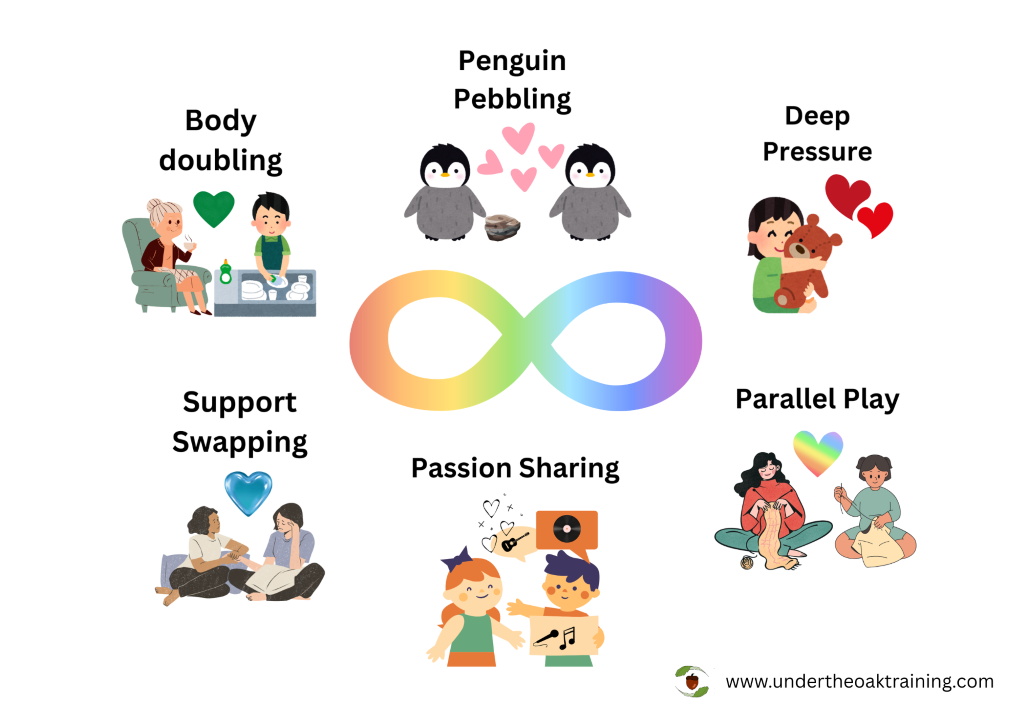
While no two experiences of neurodivergence are the same (or remain static), some regularly described neurodivergent experiences include:
- having a "Spiky Profile" whereby skills and difficulties are very distinct, can lead to confusion and people asking themselves "Why do I find that "hard" thing easy and that "easy" thing hard?". Others may also underestimate and exclude folks when they notice only what they find hard and place unreasnoble demands and expectations when they observe only the skills. Dana brings curiosity to validating what makes people's brains light up and what seems to go missing. She is committed to offering practical strategies embedded in self compassion.
- overwhelm or understimulation (or, somehow, both) can lead to meltdowns, shutdowms, inertia and burn out. Dana takes a detailed analytical approach to understand what adds to and depletes energy in each person's day and life. From here, subtle changes can make a huge difference to prevent, reduce or recover from emotional distress.
- Monotropism and hyperfocus can lead to flow state wellbeing, creative works and passion projects. It can also interfere will needs, roles and responsibilities in other life areas. Dana shares ways of making enough space for flow while balancing other needs.
- co-occuring body differences like hypermobility, POTS, Developmental Coordination Disorder, vision differences and more intense reactions to hormonal cycles (e.g. premenstrual dysphoria) and transitions (e.g. peri-menopause).
- differences in memory and learning - for example some folks are aphantasic (no internal visual images) and others may be hyperphasic (photographic memory). For some people words link into a web of meanings and connections, for others words can be transient and hard to recall.
- different internal sense of time (e.g. struggle with linear time but connect more with cycles and seasonal changes)
- low interoception making body needs (e.g. hunger, tiredness) and/or emotional responses in the body delayed and/or less specific.
Dana offers in-person counselling sessions from Northside Therapy Collective, 680 High St, Thornbury, Vic 3071 (level 1, above Premier Sports and Spinal Medicine). This beautiful space is curated to offer sensory rest and stimulation, with therapists who are passionate about ethics in practice. My room is called The Loft and feels a bit like a cubby, treehouse or attic retreat. It is filled with fidgets, art from local artists, a weighted blanket, split system for temperature management and a window view of the sky. There are creative materials to explore and "walk and talk" sessions in the local area can support gentle de-sensitising to social stressors. Dana also offers sessuibs by phone and video conference. Unique text based therapy may also be supportive for folks with Situational Non-speaking.
The fee for a 55 minute session is $130 with some concession appointments ($100) available on request. Unfortunately, Dana is not able to offer Medicare rebates for her services. Medicare only provides rebates for professionals with training as psychologists, clinical psychologists or mental health social workers - they do not recognise counselling or psychotherapy trained individuals for their rebates. NDIS clients who are self or plan managed are able to use Psychosocial Recovery Coaching funding for this service.
Learn more about specialty training Dana has completed here.
To inquire about an appointment with Dana, please call 0431 829 498, email dana@undertheoaktraining.com or use the contact form.